Sản phẩm


.svg)


.svg)


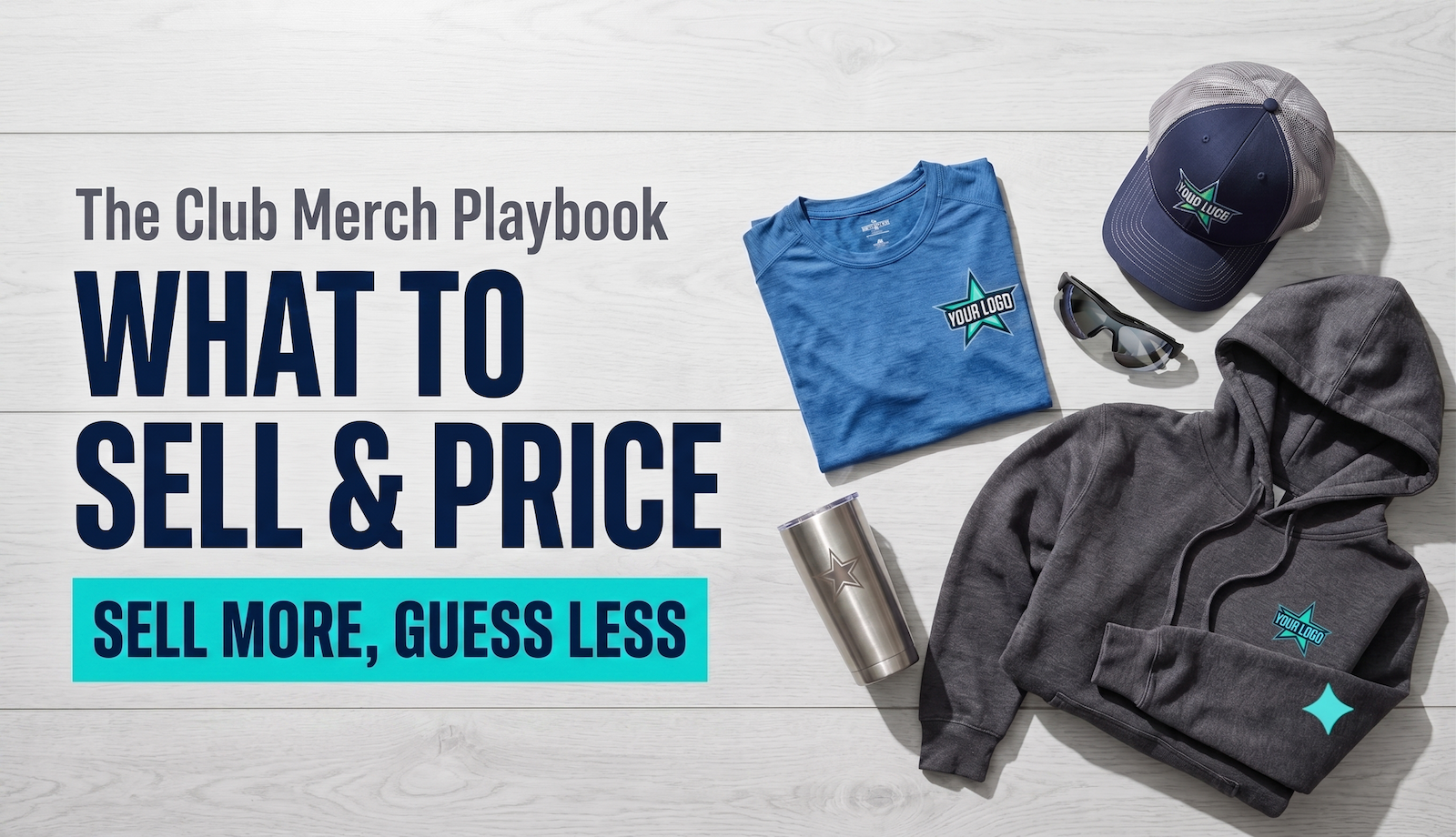
If you've ever run merch for a running crew, a swim team, or a weekend cycling group, you already know the drill. There's a group chat full of "what size again?" messages. There's a spreadsheet with half the names spelled wrong. There's a Venmo request you sent three times. And somewhere in a teammate's garage, there's a box of extra-large shirts nobody wanted, purchased with money the club fronted before a single one sold.
None of that is a "you" problem — it's a merch-model problem. Most clubs are stuck ordering in bulk, guessing at sizes, and eating the cost of what doesn't move. This guide skips the theory and gets into what to actually put in a club store, how to price it so the club keeps a real margin without doing algebra, and which pieces members buy again and again versus the ones that sit unsold.
The Unisex Short Sleeve Classic Tee is the anchor piece almost every club needs on day one — it's the item members wear the morning of a race or meet.
How to use your logo: If you already have a club crest or wordmark, keep it small and centered on the chest (under 4 inches wide holds up best on a lightweight tee), and save any bigger element — event name, date, distance — for the back, where it's visible to everyone standing behind the runner at the start line. Members typically wear this once per event, so it doesn't need to carry the whole design load. GearLaunch prints apparel like this tee with sublimation or DTG (direct-to-garment), so a multi-color or gradient logo prints in full color without needing a separate screen for every color — there's no extra setup step just because your crest isn't a single flat color.
Base cost: $9.33 (Blue tier).
Shipping (US): $6.19 for the first unit, $2.15 for each additional unit.
The Unisex Heavyweight Pullover Hoodie is the piece that turns a one-time race tee buyer into a repeat customer — it's warm, it's flattering on everyone, and people actually wear it around town, not just at practice.
How to use your logo: Heavyweight fleece holds detail better than a tee, so this is a good spot for your full crest at a slightly larger size, or a full back print if your logo has more detail worth showing off. Since parents and alumni tend to buy this one to wear well past the season, a design that reads as "our club" rather than "this one event" gets more long-term wear out of it. If your crest is the kind of thing your club takes real pride in, this is also the piece worth embroidering instead of printing — a stitched crest on the chest reads as official team gear in a way a print never quite does, and it's what most clubs reach for when they want something that looks like it belongs on real uniform-grade apparel.
Base cost: $18.50 (Blue tier).
Shipping (US): $8.49 for the first unit, $3.15 for each additional unit.
A Mesh Trucker Hat is the lowest-commitment purchase in the lineup — it's cheap to make, easy to wear daily, and it turns members into walking billboards at the grocery store, not just at events.
How to use your logo: Use the front foam panel and keep it bold — small text or fine detail in your logo tends to get lost on the curved, textured surface, so if your crest has a lot of fine linework, consider a simplified initials or icon version just for this product.
Base cost: $12.49 (Blue tier).
Shipping (US): $5.27 for the first unit, $6.99 for each additional unit.
The 16" x 16" Basketweave Tote Bag covers the practical side of merch — a bag members and parents will genuinely use for gear, groceries, or hauling snacks to the meet.
How to use your logo: Bold, single-color versions of your logo print cleanest on the tote's woven texture. If your existing design has gradients or a photo-style background, a flattened, single-color version will read far more clearly from across a parking lot than the original file would.
Base cost: $14.00 (Blue tier).
Shipping (US): $6.99 for the first unit, $2.99 for each additional unit.
A 15oz Insulated Travel Tumbler fills the drinkware slot — a piece members reach for at every single practice, which keeps the club logo in front of them constantly.
How to use your logo: Wrap-around placement works well on a tumbler's curved surface, but keep any text in your design large enough to read at arm's length. A name or year on the base plus your logo on the body is a reliable, low-effort combination if you're reusing an existing design rather than creating something new.
Base cost: $12.90 (Blue tier).
Shipping (US): $6.99 for the first unit, $4.99 for each additional unit.
Pricing tiers and shipping rates above can change — always check the Platform Product Summary to confirm current numbers before you finalize retail prices.
Most club leaders freeze up at the pricing step because it feels like it requires a spreadsheet formula. It doesn't have to. The simplest way to think about it: your retail price is the base cost, plus what it actually costs to have it made and shipped, plus a margin the club keeps for every single sale. That margin is what funds the season — new equipment, travel, whatever the club needs — and it should be baked into the price before the store ever goes live, not calculated after the fact from whatever's left over.
The clubs that get this right don't set one price and hope. They think about it per product: a $9 tee has more room to add margin than a low-cost item with slim base costs, while a hoodie's higher base cost means the margin per unit matters more than the volume. Set it once, correctly, and every sale banks the same margin automatically — no re-checking a spreadsheet mid-season, no guessing what you actually cleared until the year is over. If you want more product ideas in the same profit-first mindset, GearLaunch's best-selling print-on-demand products roundup is a useful next read for expanding a lineup once these five are dialed in.
A few patterns hold true across almost every club store, regardless of sport. Items members can wear more than once — hoodies, hats, tumblers — consistently outsell single-occasion pieces like a plain event tee, simply because the cost-per-wear feels better to the buyer. And the more emotional the moment attached to a product, the easier it sells: a "season finisher" hoodie or a "first race" tee moves faster than the exact same blank item with a generic logo, because people aren't just buying fabric — they're buying a memory they get to keep wearing.
The other pattern worth knowing: parents and supporters often outspend the athletes themselves. A member might buy one tee for the season, but a parent will often buy a hoodie, a hat, and a tumbler across a few months if the store stays open and easy to reach. That's the argument for stocking real fan gear from day one instead of treating it as an afterthought.
Everything above assumes one thing that trips most clubs up: not having to buy inventory before you know what sells. Nothing here requires guessing quantities or paying a printer upfront — items are only produced once a member or supporter actually buys, which is the difference between a club treasurer sweating over a bulk invoice and a club simply collecting a check at the end of the month.
It's also worth knowing that "print-on-demand" doesn't mean you're stuck with one flat, single-color logo across everything. GearLaunch's catalog runs on sublimation and DTG for most apparel, and beyond that, the full lineup includes embroidery, UV DTF, laser engraving, and liquid 3D printing — a technique that adds real physical texture and depth so a design doesn't just sit flat on the surface. Clubs tend to have more pride in their crest than almost any other kind of organization, and gear that actually looks like it belongs on official uniform apparel — a stitched crest instead of a printed one, or a design with real dimension to it — is usually worth the small step up from a standard tee print.
None of this requires you to become a designer or a print expert to get it right. If your club wants a store built around this exact lineup — logo placement, decoration method, and product picks handled by an actual team rather than a self-serve tool — that's the whole idea behind GearLaunch for sports clubs.
What products should a small sports club start with? Start with two or three pieces that cover both core gear and fan gear — a tee for race day, a hoodie for the off-season, and one accessory like a hat or tumbler. Five items is a manageable ceiling before a store starts feeling cluttered.
How do clubs avoid leftover inventory? By not pre-ordering in bulk. When items are only produced after someone buys, there's no leftover box of unsold mediums to store in a garage between seasons.
What's the difference between core gear and fan gear? Core gear is what athletes wear to train and compete — tees, technical layers, anything crest-forward. Fan gear is what parents and supporters buy to wear casually, like hoodies, hats, and bags. A balanced store sells both.
Do club leaders need to know printing techniques to get good results? No — but it helps to know the options exist. GearLaunch produces most apparel with sublimation or DTG, and the broader catalog also includes embroidery, UV DTF, laser engraving, and liquid 3D printing for added texture. A good store setup matches the method to the piece — like embroidery for a chest crest versus a full-color back print — rather than using one technique for everything.
How should a club price merch to actually make money? Build the margin into the retail price up front — base cost plus production and shipping plus a set amount the club keeps — rather than pricing low and hoping there's something left over after expenses.
Do club members really buy more than one item per season? Often, yes — especially parents and supporters, who tend to pick up a hoodie, a hat, or a tumbler in addition to a single event tee, particularly when a store stays open past just race day.


.svg)
.svg)
.svg)